Friday, 16 June 2017

Farewell Message: HNC Students 2017


Thanks to all HNC Creative Media Production students for your hard work, effort and support this year. It has been most appreciated.

We all look forward to hearing of your continued success in the future and will miss your company.

Please take a moment to watch this video and listen to the lyrics. 

Friday, 3 March 2017

“Daydreaming,” Radiohead And Paul Thomas Anderson - Music Video


Last Friday, Radiohead followed the surprise release of their “Burn The Witch” video with another surprise: the release of a second song, “Daydreaming,” accompanied by not only the announcement that their new album would suddenly be out Sunday afternoon, but also a hauntingly mesmerizing video directed by Paul Thomas Anderson. (If you have been on the internet at all in the past week, I can’t imagine how you would’ve avoided being barraged by this information — plus the video has been screening at select movie theaters nationwide — but, you know, there it is, just in case you missed it.)
The “Daydreaming” video marked the first collaboration between the director and the full band, though there have been explicit ties between them for almost a decade, and more abstract connections that extend back even father. Both Radiohead and Anderson are famous, mostly-mainstream juggernauts who have reigned over their respective scenes for around two decades, garnering consistent critical adoration as well as the fervent fan devotion. In hindsight, such a direct collision of their worlds almost feels overdue.

Tuesday, 31 January 2017

Promotional Video Production: Sample


Brief
The client required a video showcasing the Camden and Chalk Farm area for prospective buyers in other countries. The video was to have a very specific look and feel to tie in with the website, branding, and to appeal to the target market. They had worked with other production companies, but wanted to see if they could achieve better results.

Production/Exhibition
Following more detailed discussions, filming took place around the Camden area, the style of edit would require a large quantity of individual shots. These were taken with a DSLR camera to give a greater depth of field and to give the final video a very stylised look. The content was intercut with CGI fly-through’ s produced by the client and set to music. The client was delighted with the final edit, and a second project is currently in pre-production as well as plans for an extensive range of video clips to be interspersed through the agencies’ new website.

Friday, 11 November 2016

What To Do With A Film Studies Degree


The film industry is notoriously competitive, but graduates will have developed a highly transferable range of skills.

You don't need a film studies degree to be the next Alfred Hitchcock or Quentin Tarantino, but it could put you on the right path.
Film studies degrees offer the chance to gain hands-on experience of film-making and also touch on topics such as film history, theory and criticism. Students study everything from Hollywood blockbusters to art house movies, taking in screenwriting, critiquing and directing along the way.
Famous graduates include Paul WS Anderson, director of video game adaptation Mortal Kombat. Anderson graduated with a degree in film and literature from Warwick University and is also behind such box-office successes as Resident Evil and Alien vs. Predator.

What skills have you gained?

As well as practical film-making skills such as how to operate a camera and edit footage, you will have developed skills which will make you attractive to employers in a wide variety of fields. These include good research and communication skills, critical thinking, project management and the ability to organise your time effectively and work to deadlines.

What jobs can you do?

Almost 60% of film studies graduates went into full-time employment in 2009. Of those, 12.5% found jobs within the art/design/culture sector and, within the film industry itself, 2.1% became directors, 1.2% video/film recorder operators and 1.4% broadcasters. Some 34% found work in retail/catering, perhaps as a temporary measure and an indication of the competitive nature of the industry.
The focus of your degree is an important factor, says Margaret Holbrough of Graduate Prospects. "Careers within the film industry are fiercely competitive and opportunities to pursue a technical or practical career will depend on the graduate's experience and the content of the degree, and whether it focuses more on hands-on film production skills as opposed to the appreciation, analysis and interpretation of films and film genres," she says.
"Within the film, TV and video industries the roles may include film/video/television editor, camera operator, photographer, art director, TV or film producer or production assistant, runner, location/props manager or programme researcher.
"In addition, the publishing industry, including printed newspapers, magazines, online publications and websites, may offer opportunities to write about films as a journalist, content manager or editor, or to work in film and picture research and archiving."
Some business areas, such as advertising, marketing and communications, may also utilise the creative and analytical abilities of film studies graduates in roles such as art directors, account managers, copywriters and market researchers.
Teaching and lecturing are also potential career options and require a postgraduate teaching qualification.

Postgraduate study?

Of those who graduated in 2009, 6% went on to study for a higher qualification. There are many masters and postgraduate diploma courses available in film studies, providing an opportunity to specialise in areas such as scriptwriting, directing, producing and final editing. Some jobs require a postgraduate qualification, such as teaching or journalism. There is also the chance to do postgraduate research in film-making.
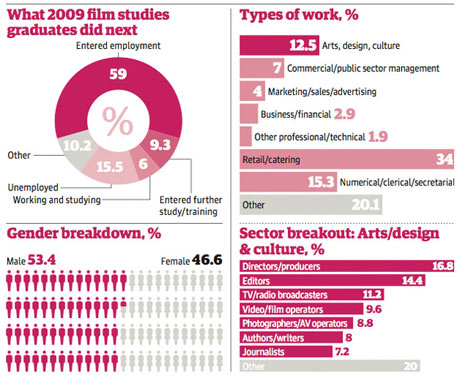
Film studies graphic
Source: The Guardian 2011

Monday, 10 October 2016

Mid Unit Assessment - Checklist:


At this stage of the year we would like you all to self-assess your progress by completing the checklist we that we have distributed (copy as above). If you have any questions please ask any of your HNC teachers.

Friday, 7 October 2016

The French New Wave: 3 Moments of radical change


1. The Blum-Byrnes Trade Agreement Of 1946 
  • American imports were regulated during this post-war period. 
  • 13 weeks were set as the maximum number for screening purely French films. 
  • This corresponded to the production capacity of the French film industry, badly hit by lack of investment during the war. 
  • TV was slow to take off. 
  • Specialist press flourished. 
  • Serious discussion of film flourished. 
  • Most particularly “Cahiers du Cinema” (1951) 
  • Cinema in France was taken extremely seriously for the first time. 
  • Art screenings and discussions were common. 
  • Created by University drop-outs this ‘counter-culture’ attempted to position cinema within the mainstream of French and European culture. 
  • Andre Bazin, Jean-Luc Godard, Francis Truffaut (critics) 


2. The Nouvelle Vague (new wave)
  • These critics went on to make films. 
  • They dispensed with the technical hierarchies required by traditional cinema. 
  • Divisions between – producer / director / editor / cameraman / actor / writer - became blurred 
  • Worked from an idea - improvised - work on other films as (actors/writers etc) 
  • Used their own apartments instead of sets & cast friends & girlfriends in starring roles. New actors and actresses employed. 
  • Subject matter changed. Literary adaptation went out the window. They wrote about things that they knew: Relationships/lives etc. 
  • They had the look of documentaries and explored the relationship between ‘fiction’ and ‘doc’ and ‘naturalism’ and ‘formalism’.
  • They also incorporated a consciousness of the history of cinema – especially Hollywood. 
3. The Events of May 1968
  • Many Directors demonstrated against the governments proposals to take over the film organisations Cinematheque. 
  • Students/workers rioting. 
  • Nouvelle vague directors were seen to be aligned with this new political radicalism. 
  • Godard’s “Le Petit Soldat” (1960) was considered critical of the war in Algeria. Was not released till 1963. 
Issues
  • Sexual politics/Gender/Prostitution/Homophobia 
Nouvelle Vague created
  • The low budget art film 
  • The director as auteur
  • Introduced a radical approach to genre and narrative