Monday, 18 September 2017

Jean-Luc Godard: The Original Auteur


When one thinks of an auteur director, who is the first that comes to mind? Martin Scorsese? The Coens? Pedro Almódovar? Though these three would all make an iconic filmmakers list, the word “auteur” would have a different meaning, if it existed at all, if it were not for Jean-Luc Godard. He matches both radical themes and eccentric characters with unconventional cinematography – breaking diegesis left, right and centre. During a time when the French film industry could only be described as “Le Cinema du Papa”, Godard rebelled in a massive way, disregarding the traditions of lavish sets, rigid scripts and willowy, upper-class characters; he had his own way of telling a story.

Born in 1930’s Paris to wealthy parents, Godard first began his quest into filmmaking when he co-founded a Gazette du cinema in 1950. A year later, his parents had cut off his financial support and left young Godard with little money but big ideas. Along with contemporaries André Bazin, Jacques Rivette and François Truffaut, Godard began his foray into experimental cinema, forming the nucleus of what we now call “French New Wave directors” or cahiers du cinéma. He dabbled in documentaries and short films before finally making his most successful and iconic feature film: Á bout de souffle.

Roughly translated as "Breathless", Godard’s first feature film, co-written by Truffaut, was released in 1960. It was praised for its uniqueness and innovation; never before has a director used the jump cut so prolifically. He uses back-to-basics filmmaking, abandoning sets in favour of real locations. He rarely uses anything but natural lighting and handheld cameras and intentionally breaks the spell of cinema. He has no problem with revealing cinematic artifice; at one point, our hero, Michel Poiccard is humming a tune while the shot cuts several times despite tune remaining intact. Poiccard also uses direct address. Here Godard uses abstract realism. His themes reflect the existential boredom suffered by the youth of the time, explored through his non-motivated dialogue and fragmented narrative.


Keyframe presents the online debut of Godardloop, a multi-part video essay on the films of Jean-Luc Godard. Produced by Michael Baute and edited by Bettina Blickwede, this video explores a treasure trove of imagery found in dozens of Godard’s features and shorts, grouping them among several distinct themes. 47 films spanning 50 years of filmmaking are transformed into a stream of images that attest to an inimitable talent: an artist who can transform the world simply by the way he looks at it through his camera.


Italian Neorealism


Before the indies and even before the French New Wave, Italian neo-realism staked out new cinematic territory. One of those blanket terms that mean all things to all people, neo-realism has few absolutes, though there are elements that set the Italian version distinctly apart. Screenwriter and poet Cesare Zavattini wrote an actual manifesto to guide these films, but their creation was just as much a result of timing, chance and fluke. 

Unquestionably, their greatest single influence was the anti-Fascism that marked World War II's immediate postwar period. Key elements are an emphasis on real lives (close to but not quite documentary style), an entirely or largely non-professional cast, and a focus on collectivity rather than the individual. Solidarity is important, along with an implicit criticism of the status quo. Plot and story come about organically from these episodes and often turn on quite tiny moments. Cinematically, neo-realism pushed filmmakers out of the studio and on to the streets, the camera freed-up and more vernacular, the emphasis away from fantasy and towards reality. Despite the rather short run - 1943 to 1952 - the heavyweight films of the period and the principles that guided them put Italian cinema on the map at the time and continue to shape contemporary global filmmaking.

From: GreenCine

Italian Neorealism (Student Video Essay) from Kelli Marshall on Vimeo.

Friday, 16 June 2017

Farewell Message: HNC Students 2017


Thanks to all HNC Creative Media Production students for your hard work, effort and support this year. It has been most appreciated.

We all look forward to hearing of your continued success in the future and will miss your company.

Please take a moment to watch this video and listen to the lyrics. 

Friday, 3 March 2017

“Daydreaming,” Radiohead And Paul Thomas Anderson - Music Video


Last Friday, Radiohead followed the surprise release of their “Burn The Witch” video with another surprise: the release of a second song, “Daydreaming,” accompanied by not only the announcement that their new album would suddenly be out Sunday afternoon, but also a hauntingly mesmerizing video directed by Paul Thomas Anderson. (If you have been on the internet at all in the past week, I can’t imagine how you would’ve avoided being barraged by this information — plus the video has been screening at select movie theaters nationwide — but, you know, there it is, just in case you missed it.)
The “Daydreaming” video marked the first collaboration between the director and the full band, though there have been explicit ties between them for almost a decade, and more abstract connections that extend back even father. Both Radiohead and Anderson are famous, mostly-mainstream juggernauts who have reigned over their respective scenes for around two decades, garnering consistent critical adoration as well as the fervent fan devotion. In hindsight, such a direct collision of their worlds almost feels overdue.

Tuesday, 31 January 2017

Promotional Video Production: Sample


Brief
The client required a video showcasing the Camden and Chalk Farm area for prospective buyers in other countries. The video was to have a very specific look and feel to tie in with the website, branding, and to appeal to the target market. They had worked with other production companies, but wanted to see if they could achieve better results.

Production/Exhibition
Following more detailed discussions, filming took place around the Camden area, the style of edit would require a large quantity of individual shots. These were taken with a DSLR camera to give a greater depth of field and to give the final video a very stylised look. The content was intercut with CGI fly-through’ s produced by the client and set to music. The client was delighted with the final edit, and a second project is currently in pre-production as well as plans for an extensive range of video clips to be interspersed through the agencies’ new website.

Friday, 11 November 2016

What To Do With A Film Studies Degree


The film industry is notoriously competitive, but graduates will have developed a highly transferable range of skills.

You don't need a film studies degree to be the next Alfred Hitchcock or Quentin Tarantino, but it could put you on the right path.
Film studies degrees offer the chance to gain hands-on experience of film-making and also touch on topics such as film history, theory and criticism. Students study everything from Hollywood blockbusters to art house movies, taking in screenwriting, critiquing and directing along the way.
Famous graduates include Paul WS Anderson, director of video game adaptation Mortal Kombat. Anderson graduated with a degree in film and literature from Warwick University and is also behind such box-office successes as Resident Evil and Alien vs. Predator.

What skills have you gained?

As well as practical film-making skills such as how to operate a camera and edit footage, you will have developed skills which will make you attractive to employers in a wide variety of fields. These include good research and communication skills, critical thinking, project management and the ability to organise your time effectively and work to deadlines.

What jobs can you do?

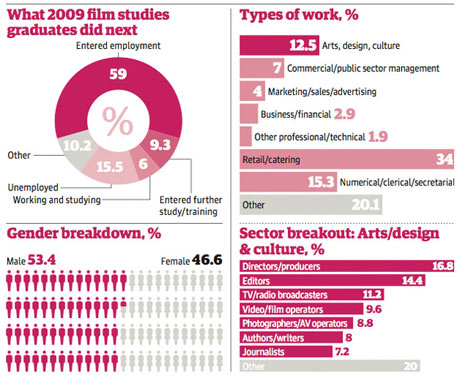
Almost 60% of film studies graduates went into full-time employment in 2009. Of those, 12.5% found jobs within the art/design/culture sector and, within the film industry itself, 2.1% became directors, 1.2% video/film recorder operators and 1.4% broadcasters. Some 34% found work in retail/catering, perhaps as a temporary measure and an indication of the competitive nature of the industry.
The focus of your degree is an important factor, says Margaret Holbrough of Graduate Prospects. "Careers within the film industry are fiercely competitive and opportunities to pursue a technical or practical career will depend on the graduate's experience and the content of the degree, and whether it focuses more on hands-on film production skills as opposed to the appreciation, analysis and interpretation of films and film genres," she says.
"Within the film, TV and video industries the roles may include film/video/television editor, camera operator, photographer, art director, TV or film producer or production assistant, runner, location/props manager or programme researcher.
"In addition, the publishing industry, including printed newspapers, magazines, online publications and websites, may offer opportunities to write about films as a journalist, content manager or editor, or to work in film and picture research and archiving."
Some business areas, such as advertising, marketing and communications, may also utilise the creative and analytical abilities of film studies graduates in roles such as art directors, account managers, copywriters and market researchers.
Teaching and lecturing are also potential career options and require a postgraduate teaching qualification.

Postgraduate study?

Of those who graduated in 2009, 6% went on to study for a higher qualification. There are many masters and postgraduate diploma courses available in film studies, providing an opportunity to specialise in areas such as scriptwriting, directing, producing and final editing. Some jobs require a postgraduate qualification, such as teaching or journalism. There is also the chance to do postgraduate research in film-making.
Film studies graphic
Source: The Guardian 2011